
Guide
Order block: what it is and how to find one
What is an order block?
In Smart Money Concepts (SMC), an order block (OB) is a price zone where larger participants are assumed to have left unfilled orders. On the chart it is defined by a simple pattern:
- Bullish order block: the last down (bearish) candle before a strong move up that breaks a recent swing high.
- Bearish order block: the last up (bullish) candle before a strong move down that breaks a recent swing low.
The idea is that when price returns to the zone (a retest, or mitigation in ICT vocabulary), part of those orders is still resting there and price may react. Whether that is really institutional behaviour cannot be verified from a chart, so treat an order block as a map of areas where reactions have a reason to happen, not as proof of who is trading.
How to find an order block
- Find the impulse. Look for a strong move (long candles, little overlap) that closes beyond the previous swing high (bullish) or swing low (bearish). That close is the structure break; see CHoCH vs BOS.
- Walk back to the origin. Pick the last opposite-coloured candle before the move began. If several small candles precede it, some traders take the whole cluster as one block.
- Draw the zone. Common choices are the candle's full range (high to low) or its body (open to close). Decide the rule first and apply it the same way every time.
- Extend it to the right until price comes back, or until a candle closes through the zone.
- Add context. Zones with more going for them usually sit near a liquidity sweep, overlap a fair value gap, or lie in the discount half of the range (for longs) or the premium half (for shorts).
| Bullish order block | Bearish order block | |
|---|---|---|
| Candle to mark | Last down candle before the up-move | Last up candle before the down-move |
| Structure break | Close above a recent swing high | Close below a recent swing low |
| Expected reaction | Price dips into the zone and holds | Price rallies into the zone and fails |
| Invalidation | A close below the zone | A close above the zone |
Order block example
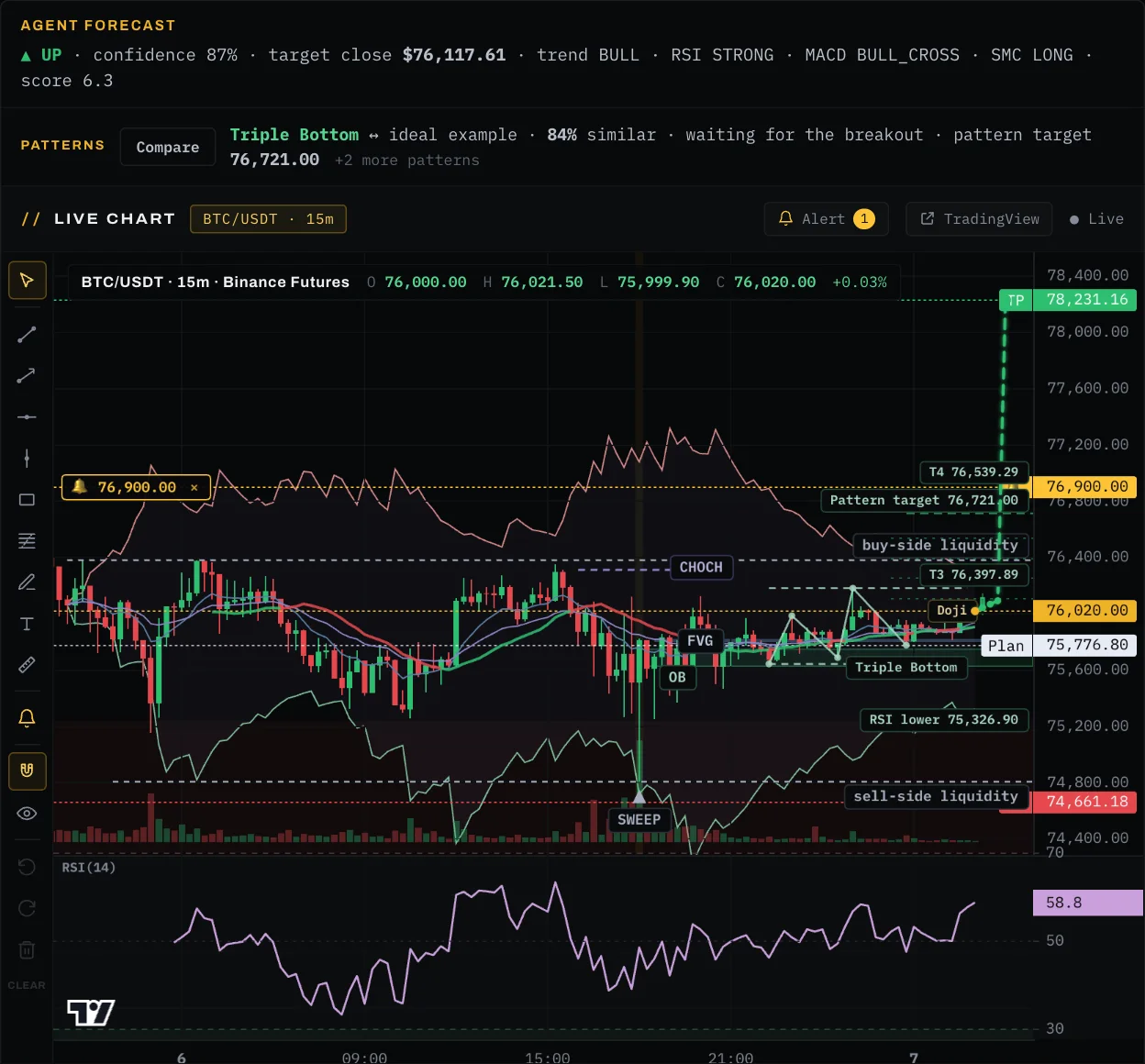
In the example the sequence reads like a textbook case. A wick sweeps the sell-side liquidity near 74,810.80. Price then breaks the falling high at 76,313.40 (a CHoCH). The move leaves a bullish order block at 75,623.20–75,753.60 and a fair value gap at 75,800.00–75,821.00 close together, and the agent's plan puts its entry inside that confluence. One zone alone would be weaker; stacked evidence is what traders look for.
How to trade an order block
This is a common workflow described for education, not a recommendation:
- Wait for price to come back. Chasing the impulse means buying the high; the order block idea is to let price return to the zone.
- Look for confirmation on a lower timeframe, such as a small structure shift inside the zone, instead of entering blindly at the edge.
- Place the stop beyond the zone. If a candle closes through it, the idea is wrong; staying in is hope, not a plan.
- Aim at the next liquidity (the previous swing high or low) and check the risk/reward ratio before you enter; see risk/reward ratio.
- Size the position from the stop distance, so a loss stays within what you decided to risk.
When order blocks fail
- Too many zones. On a busy chart you can find an "order block" almost anywhere. Require a real structure break and a clear impulse.
- The zone is closed through. After a close beyond the zone it no longer protects the idea. Some traders then watch it as a breaker block, a failed order block that may act from the other side.
- Weak context. A zone against the higher-timeframe trend, in the middle of a range, or with no liquidity event nearby has little going for it.
- Hindsight bias. Tutorial charts are picked because they worked. Mark zones in real time and keep a record, including the misses.
- It is not a statistic. Nobody can quote a trustworthy win rate for "order blocks" in general, because the definition is discretionary.
How tradeagentio handles order blocks
On every new candle the tradeagentio analysis engine runs liquidity, fair value gaps, order blocks, 20 indicators and a chart pattern scan, and joins them into one plan: direction, entry, stop and target. The order block it draws is the last opposing candle before the impulse, shown next to the other structures it found. You can read the same logic on the chart yourself; the agent writes its reasoning to a log, step by step. tradeagentio does not send orders to any exchange.
Frequently asked questions
What is an order block in trading?
An order block is the last candle against the prevailing move before a strong, structure-breaking impulse. Traders mark its range as an area where price may react on a return. It is a reference zone from Smart Money Concepts, not a guaranteed reversal point.
How do you find an order block?
Find a strong move that breaks a recent swing high or low, then mark the last opposite-coloured candle before that move began. Draw the high-to-low range (or the body) and extend it to the right. Zones that line up with a liquidity sweep or a fair value gap carry more weight.
What is the difference between an order block and a fair value gap?
An order block is a candle-based zone: the origin of an impulse. A fair value gap is a three-candle imbalance where the first and third candles' wicks do not overlap. They often appear together, and price sometimes reacts where both overlap. See fair value gap.
What are a breaker block and a rejection block?
Definitions vary between educators. A breaker block usually means an order block that failed, price closed through it and the zone may now act from the opposite side. A rejection block is a zone built from the long wick of a rejection candle at a swing high or low instead of the candle's body.
Do order blocks work in crypto?
Crypto trades around the clock and wicks are common, so zones are often tested more than once and sometimes break. Many traders mark order blocks on higher timeframes and use lower ones for entries, but there is no verified statistic that they work. Test the idea on your own records before risking money.
See it on a live chart
tradeagentio draws these structures on live Binance data and writes an entry · stop · target plan. Free account; in the browser or on Windows.
Educational content, not investment advice. Leveraged trading is high risk and you can lose your margin quickly. Patterns describe the past and do not guarantee future results.