
Guide
Liquidity sweep: meaning, examples and how traders read it
What is liquidity in trading?
In Smart Money Concepts, liquidity means resting orders that others can trade against. They gather at places that are easy to see:
- Buy-side liquidity above swing highs and equal highs: stops of short sellers and breakout buy orders.
- Sell-side liquidity below swing lows and equal lows: stops of long holders and breakout sell orders.
- Round numbers and previous day or week highs and lows.
- On leveraged futures, price areas where positions would be liquidated.
The assumption is that large participants need this liquidity to fill big orders, so price is often drawn toward it. That is an interpretation, not something a chart can prove.
What is a liquidity sweep?
A sweep happens when price pushes beyond one of those levels, triggers the orders resting there, and then comes back. On the chart it usually looks like a long wick beyond the level with a close back inside the previous range. The wick is the sweep; the close is the evidence that the breakout did not hold.
Sweep or breakout?
In real time a sweep and a genuine breakout look the same for a moment. These are the signals traders compare:
| Liquidity sweep | Genuine breakout | |
|---|---|---|
| Candle | Long wick beyond the level, close back inside | Body closes beyond the level |
| Follow-through | Price quickly returns into the range | Price keeps going or holds above/below the level |
| Retest | The swept level is not held | The old level acts as support/resistance on a retest |
| After it | Often a CHoCH in the opposite direction | Often a BOS in the same direction |
Liquidity sweep example
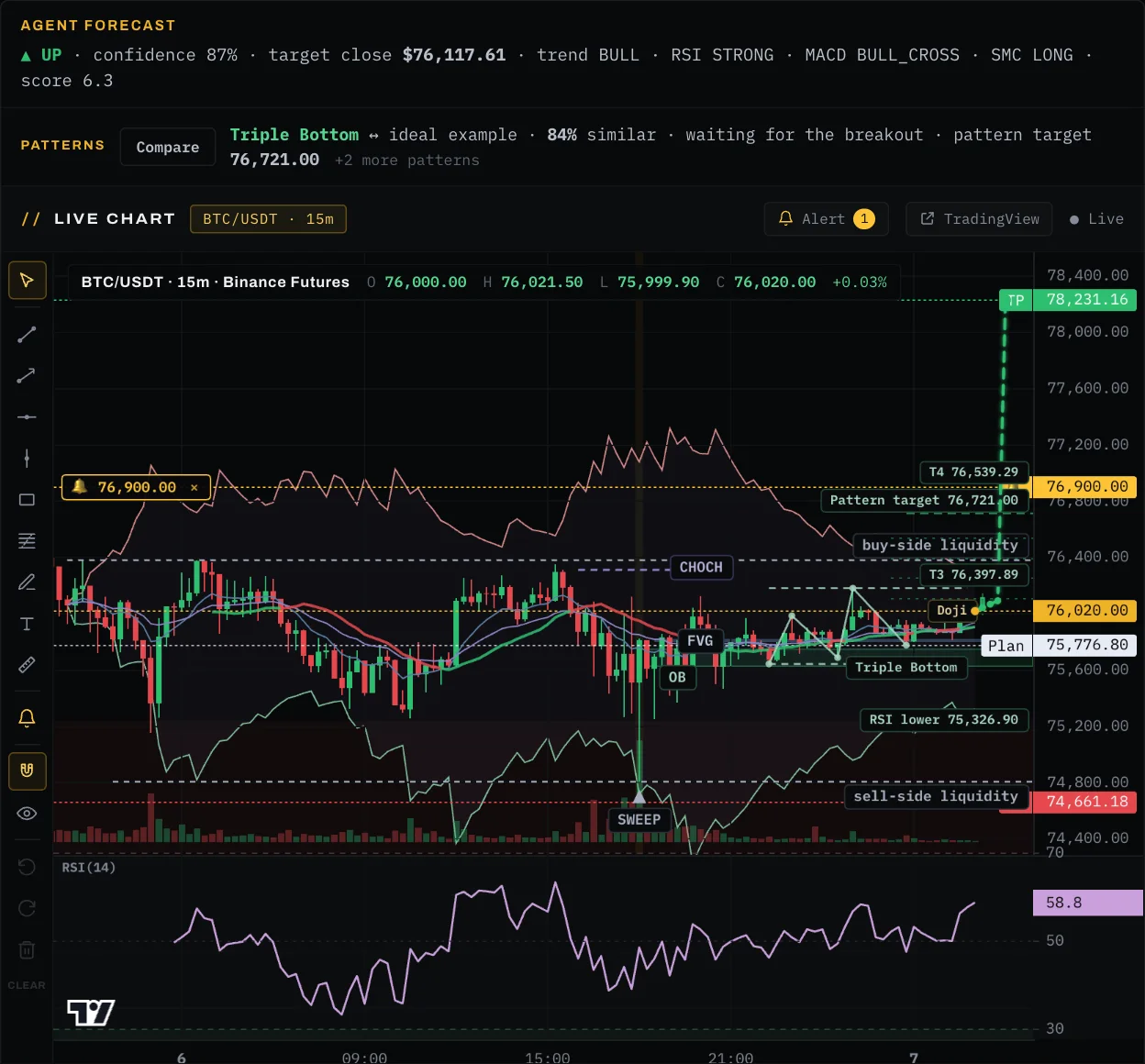
Here the agent marked sell-side liquidity near 74,810.80 and detected a wick at that level. Price then moved back into the range and later broke the falling high at 76,313.40, a CHoCH. The agent's log reads "Liquidity sweep: a wick at 74,810.80 was detected → stop-hunt confirmed." The sweep alone is not a signal; it becomes interesting when a structure shift follows it.
Stop hunt, liquidity grab, liquidity run, inducement
The vocabulary is loose:
- Stop hunt and liquidity grab usually mean the same thing as a sweep. "Stop hunt" also implies intent, which cannot be proved from a chart.
- Liquidity run is sometimes used for a move that takes the level and keeps going, in contrast to a sweep that reverses. Other educators use the two terms interchangeably.
- Inducement is a minor swing high or low that tempts traders into an early entry before price takes it out and moves the other way.
How traders use sweeps
This is a common workflow, described for education and not as a recommendation:
- Mark the obvious highs and lows, and equal highs or lows, on a higher timeframe.
- Wait for a wick through one of them and a candle close back inside.
- Wait for a structure shift (CHoCH) in the opposite direction.
- Mark the order block and the fair value gap left by that move and wait for a return.
- Place the stop beyond the sweep's extreme, aim at the opposite liquidity, and check the risk/reward ratio.
Risks
- No certainty in real time. A wick that looks like a sweep can still become a breakout on the next candle.
- Trapped traders move price too. The reaction after a sweep can be sharp both ways.
- Leverage. On futures, a fast move through a level can liquidate positions and extend the move.
- Selection bias. Examples in tutorials are chosen after the fact.
How tradeagentio handles liquidity
The tradeagentio analysis engine looks for liquidity pools above swing highs and below swing lows and marks buy-side and sell-side liquidity on the chart. When a wick takes a level and closes back inside, it labels the SWEEP and writes it to the log, then checks for a CHoCH, fair value gaps and order blocks to combine into one plan. tradeagentio does not send orders to an exchange.
Frequently asked questions
What is a liquidity sweep?
A liquidity sweep is a brief move through an obvious high or low that triggers the stops and breakout orders resting there, followed by price closing back inside the range. It is also called a stop hunt or liquidity grab.
What is the difference between a liquidity sweep and a liquidity grab?
Most traders use them as synonyms. Some educators separate a sweep that reverses from a run that continues, but the terms are not standardised, so check how a source defines them.
How can you tell a liquidity sweep from a breakout?
Look at the close and what follows. A sweep leaves a wick beyond the level, closes back inside and the level is not held. A breakout closes beyond the level and tends to hold it on a retest. In real time you often cannot be sure, which is why traders wait for a structure shift.
Does a liquidity sweep mean price will reverse?
No. A sweep is a setup to watch, not a signal. Price can sweep a level and then continue in the same direction. A CHoCH after the sweep, or a reaction at a zone, adds evidence but no guarantee.
What is inducement in trading?
Inducement is a minor swing point that tempts traders into entering early, so that price can take their stops before moving in the real direction. It is a descriptive label from Smart Money Concepts, and educators apply it differently.
See it on a live chart
tradeagentio draws these structures on live Binance data and writes an entry · stop · target plan. Free account; in the browser or on Windows.
Educational content, not investment advice. Leveraged trading is high risk and you can lose your margin quickly. Patterns describe the past and do not guarantee future results.