
Guide
Fair value gap (FVG): meaning, examples and how traders use it
What is a fair value gap?
When price moves fast, the middle candle of three can be so large that buyers (or sellers) overwhelmed the other side. The range between the first candle's extreme and the third candle's opposite extreme was never traded back and forth. Smart Money Concepts calls that range a fair value gap, and also an imbalance or inefficiency. The idea is that price sometimes returns to rebalance it.
How to find a fair value gap
Use three consecutive candles and compare the wicks of the first and the third.
| Bullish FVG | Bearish FVG | |
|---|---|---|
| Condition | Candle 1 high is below candle 3 low | Candle 1 low is above candle 3 high |
| Gap zone | From candle 1 high up to candle 3 low | From candle 3 high up to candle 1 low |
| Middle candle | A large up candle | A large down candle |
| Idea | Price may dip back into the gap, then continue up | Price may rally back into the gap, then continue down |
For example, if candle 1 has a high of 100 and candle 3 has a low of 103, the bullish fair value gap is the zone from 100 to 103.
Fair value gap example
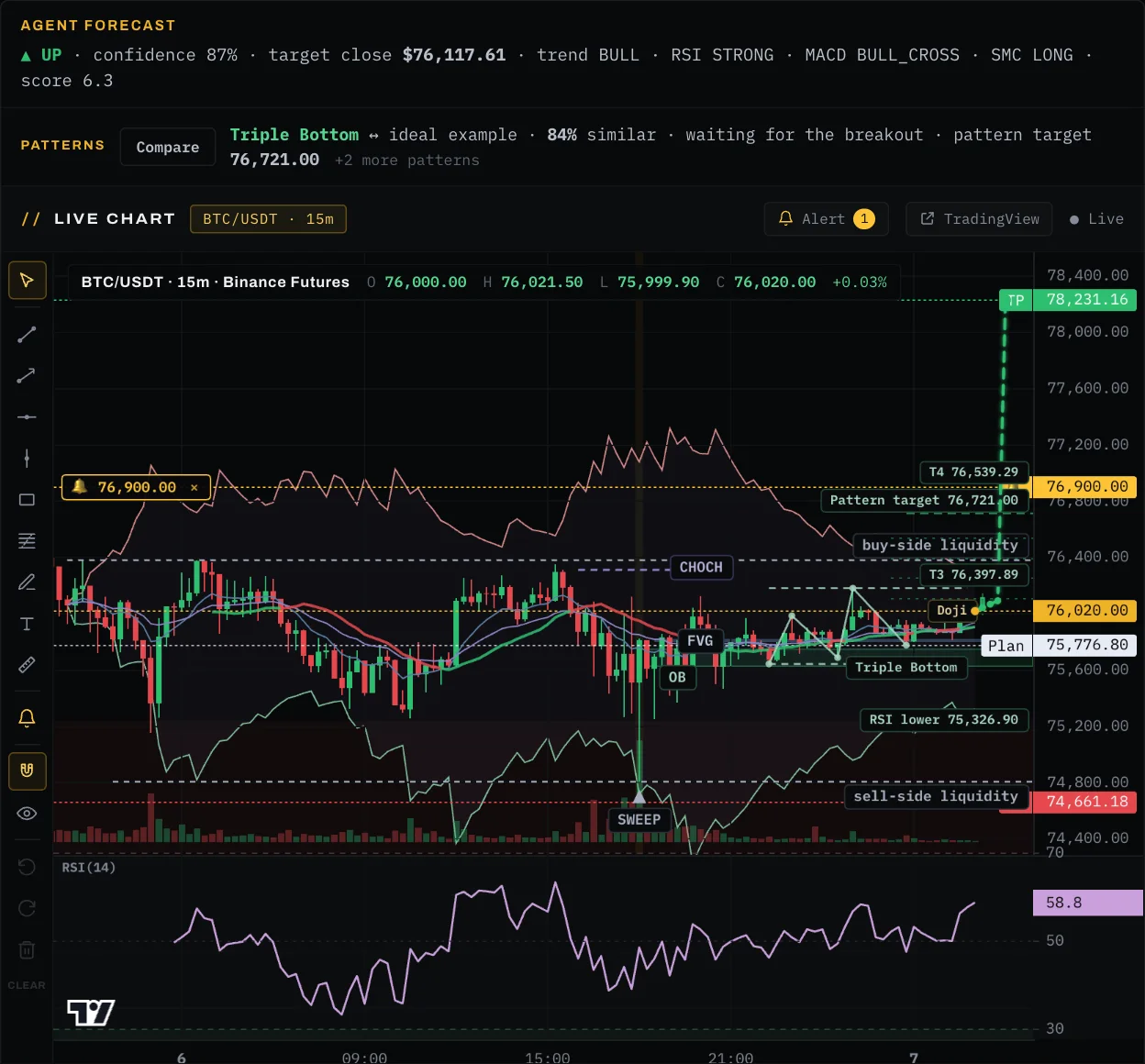
In this example the engine found a bullish fair value gap at 75,800.00–75,821.00 right next to a bullish order block at 75,623.20–75,753.60, after a sweep of the lows and a CHoCH. The entry in the plan, 75,776.80, sits between the two. The overlap is the point: traders give more weight to a gap that coincides with another structure than to a gap on its own.
How traders use fair value gaps
- As an entry zone. Wait for price to return into the gap instead of chasing the move. Some traders use the gap's midpoint (called consequent encroachment in ICT vocabulary) as a reference.
- As confluence. A gap that overlaps an order block or sits just after a liquidity sweep is usually treated as stronger.
- As a target or magnet. Unfilled gaps above or below price can be used as areas price may travel to.
- As a trend check. If price returns to a gap and holds it, the move may continue. If it closes through the whole gap, the idea is invalid.
Always check the risk/reward ratio before entering, and put the stop where the idea would be wrong, not where it is comfortable.
When fair value gaps fail
- Noise. Small gaps appear all the time. Filter by size relative to recent volatility, or require that the gap was created by a move that broke structure.
- No return. Not every gap is revisited. The claim that "all gaps fill" has no solid support.
- Closed through. A candle that closes beyond the far side of the gap means it no longer protects your idea.
- Against the trend. A bullish gap inside a strong downtrend has little going for it.
- Hindsight. Gaps are easy to see after the fact. Mark them in real time and keep a record.
How tradeagentio handles fair value gaps
The tradeagentio analysis engine checks every new candle for fair value gaps together with liquidity, order blocks, 20 indicators and a chart pattern scan. Gaps are drawn on the live chart with their price range, and the agent reports bullish and bearish confluences in its log, for example a fair value gap that overlaps an order block. It does not send orders to an exchange.
Frequently asked questions
What does FVG mean in trading?
FVG stands for fair value gap: a range left between the wicks of the first and third candles of a three-candle sequence, because the middle candle moved too fast for both sides to trade there. It is also called an imbalance.
How do you trade a fair value gap?
A common approach is to wait for price to return to the gap, look for a reaction or a small structure shift on a lower timeframe, place the stop beyond the gap, and aim at the next liquidity. Entering without confirmation, or without a stop, is the usual mistake. This is a description of a method, not a recommendation.
Does price always fill a fair value gap?
No. Many gaps are partly filled, some are filled completely and some are never revisited. Treat a gap as an area where a reaction is possible, not as a promise.
Is a fair value gap the same as a gap in stocks?
Not exactly. A stock gap appears between the close of one session and the open of the next. Crypto trades around the clock, so there are no session gaps, and a fair value gap is a pattern inside a continuous run of candles.
What is the difference between an FVG and an order block?
A fair value gap is an imbalance between three candles. An order block is the last opposite candle before a strong move. They often appear together, and the area where they overlap is the one many traders pay most attention to. See order block.
See it on a live chart
tradeagentio draws these structures on live Binance data and writes an entry · stop · target plan. Free account; in the browser or on Windows.
Educational content, not investment advice. Leveraged trading is high risk and you can lose your margin quickly. Patterns describe the past and do not guarantee future results.