
Guide
Risk/reward ratio and position size calculator for crypto
Risk/reward and position size calculator
- Direction
- —
- Risk : reward
- —
- Position size (units)
- —
- Position value (USD)
- —
- Loss at stop (USD)
- —
- Gain at target (USD)
- —
- Break-even win rate
- —
The formulas
Risk per unit      = |entry − stop|
Reward per unit    = |target − entry|
Risk/reward (R)    = reward per unit ÷ risk per unit
Amount at risk     = account × risk %
Position size      = amount at risk ÷ risk per unit
Break-even win rate = 1 ÷ (1 + R)     (before fees)
The break-even win rate shows how often a strategy must win just to stay even:
| Risk/reward | Break-even win rate |
|---|---|
| 1 : 1 | 50% |
| 1 : 1.5 | 40% |
| 1 : 2 | 33.3% |
| 1 : 3 | 25% |
Fees, funding and slippage push the real number higher, so a strategy that looks fine on paper can still lose money.
Worked example
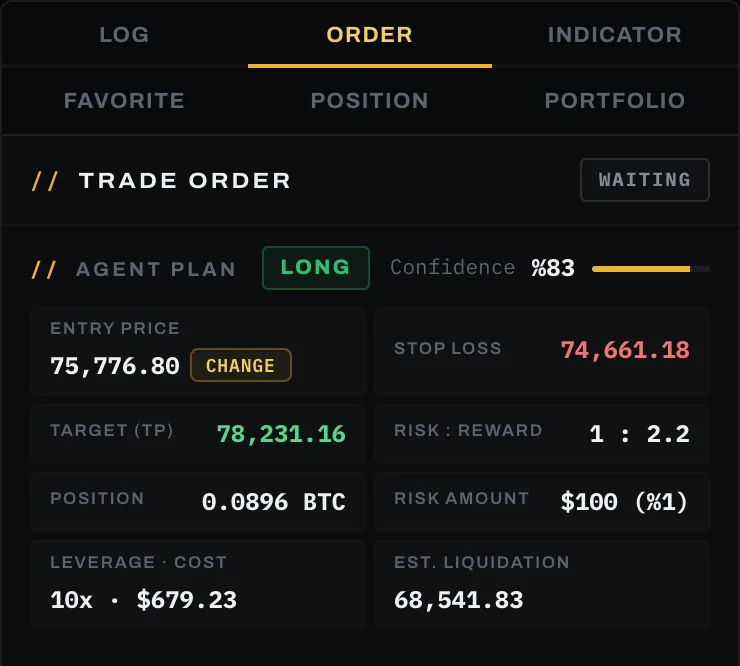
Account 10,000 USD, risk 1% per trade, so the amount at risk is 100 USD. A long on BTC/USDT with entry 75,776.80, stop 74,661.18 and target 78,231.16:
- Risk per unit = 75,776.80 − 74,661.18 = 1,115.62
- Reward per unit = 78,231.16 − 75,776.80 = 2,454.36
- R:R = 2,454.36 ÷ 1,115.62 ≈ 2.2, so 1 : 2.2
- Position size = 100 ÷ 1,115.62 ≈ 0.0896 BTC
These are the figures on the plan card of a real tradeagentio screenshot, shown here only to illustrate the arithmetic.
What is a good risk/reward ratio?
There is no universal answer. It depends on your win rate: a strategy that wins 60% of the time can be profitable at 1 : 1, while one that wins 30% needs about 1 : 2.4 or better. Many traders look for at least 1 : 2 before taking a trade, but a high ratio is worthless if the target is unrealistic. Judge targets by where price has actually reacted, for example the next support or resistance level or opposite liquidity.
Where to put the stop
Place the stop where the idea is wrong, not where the loss looks comfortable. For example, beyond an order block or beyond the swing that failed, with some room for noise (many traders use a multiple of the average true range). Then let the stop distance decide the position size, as in the formula, instead of picking a size first.
Leverage and liquidation
Leverage does not change the risk/reward ratio of a trade, which depends on entry, stop and target only. It changes how much margin you post and how close the liquidation price is. On an isolated position, a rough estimate for a long is entry × (1 − 1 ÷ leverage), so at 10x about a 10% adverse move liquidates the position, a little less once maintenance margin and fees are included. Exchanges publish exact formulas. Your stop must sit well before the liquidation price, or it will not protect you.
Frequently asked questions
What is a good risk/reward ratio?
It depends on your win rate. Many traders aim for at least 1 : 2, which needs a win rate above one third just to break even before costs. A higher ratio helps only if the target is realistic.
How do you calculate position size?
Decide how much of your account you will lose if the stop is hit (account × risk %), then divide that amount by the distance between entry and stop. The result is the number of units to buy or sell.
What win rate do I need to be profitable?
At least 1 ÷ (1 + R), where R is your average reward divided by your average risk, and more once fees and slippage are included. At 1 : 2 that is 33.3%, at 1 : 1 it is 50%.
Does leverage change risk/reward?
No. The ratio comes from entry, stop and target. Leverage changes the margin required and the liquidation distance, so with high leverage a normal pullback can liquidate you before your stop is reached.
How much should I risk per trade?
There is no right number for everyone. Many risk guides suggest keeping it small, often around 1% of the account or less, so that a losing streak does not cause serious damage. This is general information, not advice.
See it on a live chart
tradeagentio draws these structures on live Binance data and writes an entry · stop · target plan. Free account; in the browser or on Windows.
Educational content, not investment advice. Leveraged trading is high risk and you can lose your margin quickly. Patterns describe the past and do not guarantee future results.